
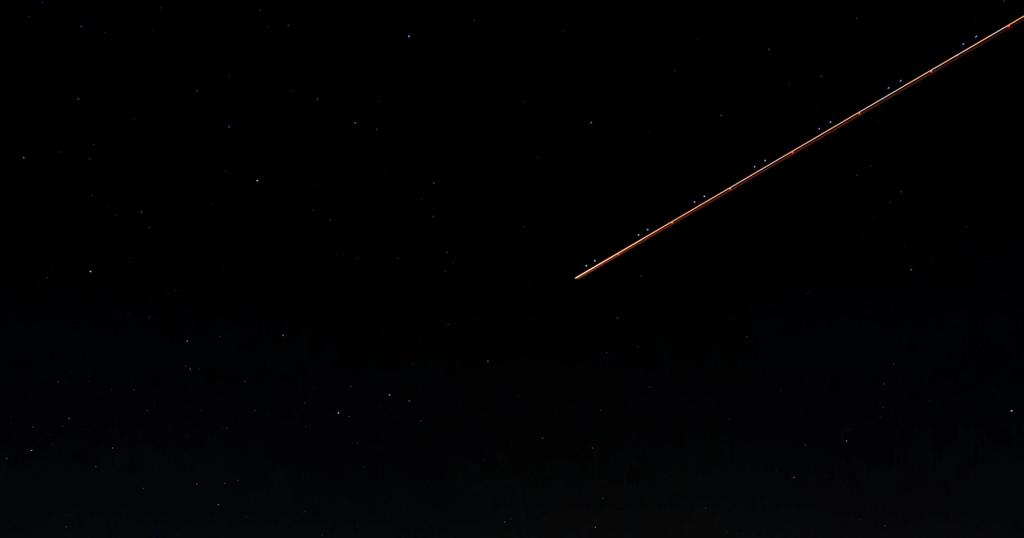
Three major meteor sightings between march 2-9. One in Vancouver and Calgary each. The next sighting appeared across multiple countries.
Vancouver
What happened?
On March 3, 2026, Vancouver experienced an illuminating object in the sky. This caused a bang that alerted neighbours across the Lower Mainland in Canada, including portions of Seattle. What flew over Vancouver toward Coquitlam was confirmed to be a meteor of a “softball” size (Canadian Broadcasting Corporation, 2026). This was confirmed by NASA to CBC. This meteor is called a bolide.
Fun Fact: The meteor was traveling at approx. 33 km/s (119,000 km/h). This is like a bullet taking 20 minutes to travel around the Earth. Do keep in mind these calculations aren’t taking into account drag, air density, and more. It’s a simple calculation made.
What is a Bolide?
A bolide is basically a bright meteor. The long definition by NASA is “exceptionally bright meteors that are spectacular enough to be seen over a very wide area” (National Aeronautics and Space Administration, 2025).
What happened to the meteor?
So far, the meteor disintegrated in the atmosphere. No extinction-level event here… (Canadian Broadcasting Corporation, 2026).
Calgary
Shortly after the Vancouver bolide, another flew over Calgary on Thursday, March 5 (Daily Hive, 2026; CityNews Calgary, 2026). This time, residents captured a clear sight of the meteor breaking up upon entry. Like the intro to Transformers (2007). For this event, there is speculation on what the residents think they saw. CityNews (Calgary) spoke to one of the people who recorded the event, stating that it could be a missile attack, then concluded it’s probably “a shooting star” (CityNews Calgary, 2026).
This did happen last Thursday, so it’s a matter of time till we get more info on this specific event. Now onto Luxembourg.
Luxembourg
This Sunday (March 8), residents have found another bolide with video evidence showing its brightness. Experts believe it’s most likely a meteor according to RTL Today (RTL Today, 2026a). This meteor took an international tour across Luxembourg, Belgium, France, the Netherlands, and Germany. Taking into account that it was the evening, it was still bright enough during the day where you can see cloud trails in the sky. As if a plane flew by. Now here’s the interesting part. There’s actual reported damage.
So far, “German police reported that fragments had fallen in the state of Rhineland-Palatinate…” (RTL Today, 2026a). The first time this week where there’s actual consequence of a meteor burning.
ESA’s take on the event
The European Space Agency wrote a concise analysis of the event. According to the ESA, the meteor illuminated the sky for six seconds. For Millennials and Gen-Z, that’s as long as a Vine video. They also confirm that fragments struck “at least one house…” (European Space Agency, 2026). No one got hurt.
Why did no one see this coming?
Large telescopes don’t usually see small entries during the daytime. According to the ESA, they are “missed in most cases” (European Space Agency, 2026). How convincing this is to you is another question to ask. Telescopes aren’t like cars where there’s an updated one each year, so this industry still uses old tech in certain areas.
The chart below shows how most meteors of a small size (between 1 to 100cm) can fall undetected by our telescopes.
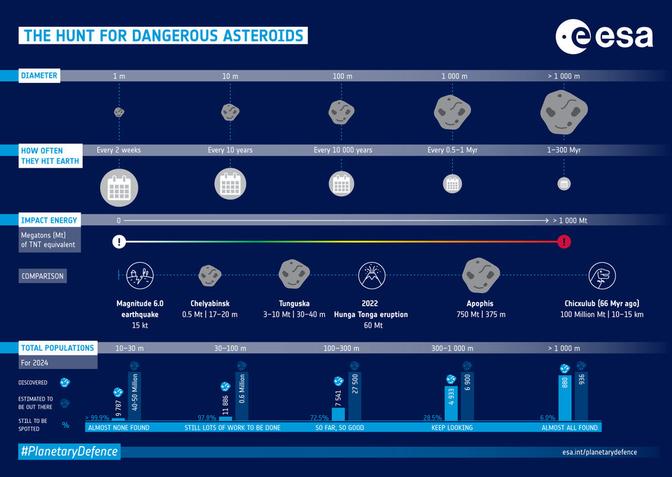
Chart 1 ~ A comparison between the Scale of a Meteor relative to the frequency of impact and severity of impact made by the ESA.
With this insight we can grasp the uniqueness of our planet by how much more there is to learn. It will require an effort, but nothing humanity hasn’t solved before.
Conclusion
These sightings are a wonder to us all. They glow bright enough to shine the sky while screaming, “I’m over here” when exploding. This, is an opportunity for Mutabie Canada Inc (and the space industry) to seek good in all of this greatness where humanity can still benefit in knowing more on what’s out there. How it’s an opportunity comes down to the current drawbacks of small meteors.
Who knows what this week or next week will bring from Canada to Germany. This would require enhanced optics and low latency hardware and software so the Canadian Space Agency (and more) can observe the night sky with ease.
Thank you all for reading this and have a wonderful spring :)
References
Canadian Broadcasting Corporation. (2026, March 4). Bright light seen in B.C.'s night sky was a ‘fireball’ meteor, NASA confirms. https://www.cbc.ca/news/canada/british-columbia/meteor-fireball-witnessed-b-c-9.7114116
CityNews Calgary. (2026, March 6). Possible fireball streaks across Calgary sky. https://calgary.citynews.ca/2026/03/06/calgary-fireball/
Daily Hive. (2026, March 5). Potential fireball blazes across Calgary sky with a wild show. https://dailyhive.com/calgary/calgary-fireball-meteor-space-debris-night
European Space Agency. (2026, March 8). ESA analysing fireball over Europe on 8 March 2026. https://www.esa.int/Space_Safety/Planetary_Defence/ESA_analysing_fireball_over_Europe_on_8_March_2026
National Aeronautics and Space Administration. (2025, March 31). Fireball and bolide reports. https://data.nasa.gov/dataset/fireball-and-bolide-reports
RTL Today. (2026a, March 8). Meteor or space debris?: Spectacular fireball spotted across Luxembourg on Sunday. https://today.rtl.lu/news/luxembourg/spectacular-fireball-spotted-across-luxembourg-on-sunday-1282669917
